
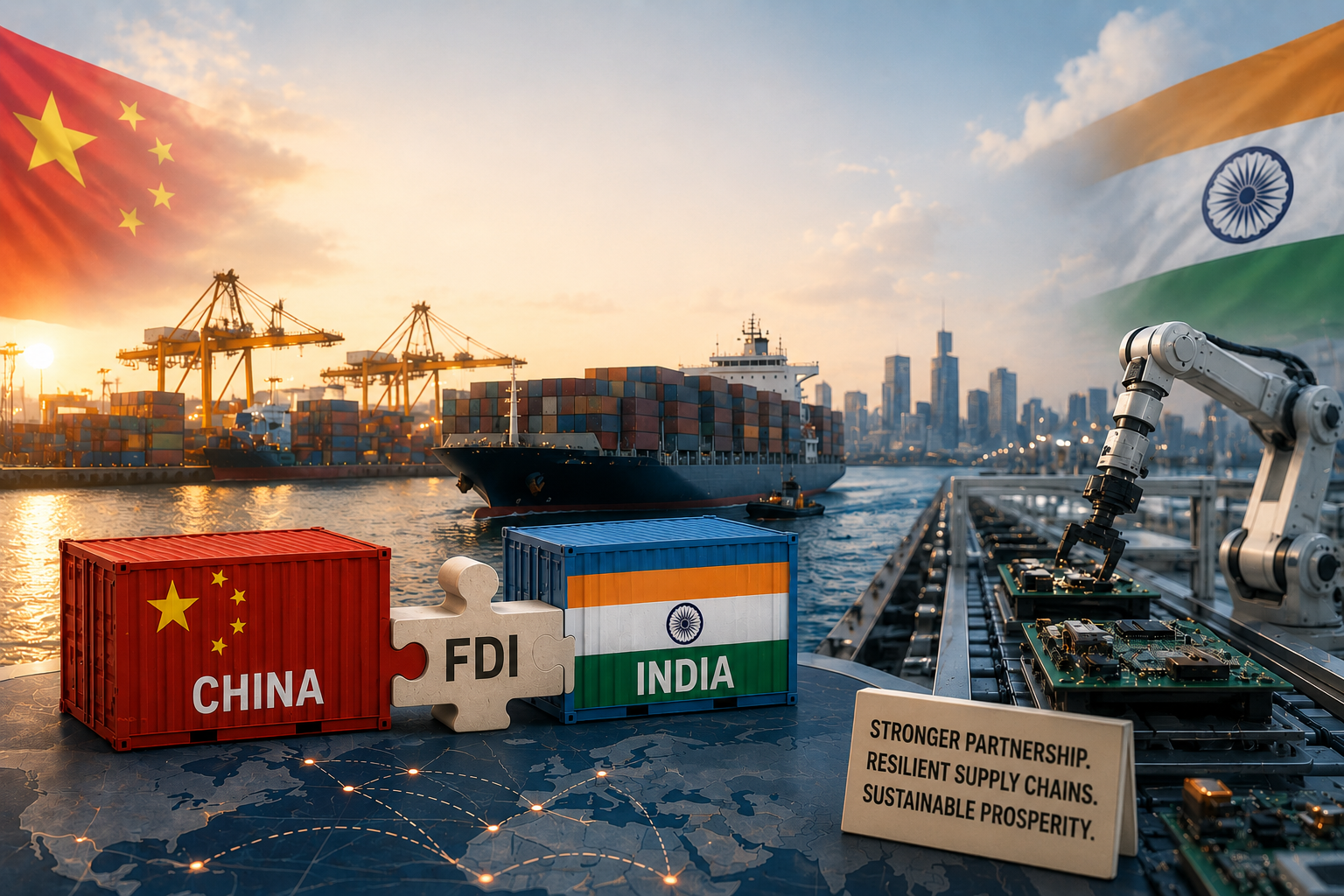
In 2020, India imposed restrictions on foreign direct investment (FDI) from countries sharing a land border, primarily to prevent Chinese firms from acquiring stakes in Indian companies. This month the government eased these rules through an amendment to Press Note 3 (2026), allowing Chinese investment of up to 10% equity under the automatic route. This threshold ensures such inflows are classified as FDI rather than foreign institutional investment (FII).
The policy shift will trigger political opposition. Has India’s adversarial relationship with China changed? What about the continuing border tensions? And can economic logic outweigh these concerns?
To answer this, one must consider the evolving global trade environment, particularly the renewed tariff disruptions associated with Donald Trump. As we have argued earlier (IE, February 4), India has responded to the need to diversify exports by accelerating free trade agreements with key partners such as the EU and the UK, with both also seeking to reduce dependence on the US. Alongside deteriorating US–China ties, this strengthens the prospects of a “China plus one” strategy, where production shifts partially away from China to countries like India. The revised Press Note 3 is a logical extension of this approach. Lets look at this in some detail.
Global production today is fragmented across borders. India’s manufacturing sector has lagged in integrating with global value chains compared to other developing economies. Meanwhile, China’s industrial structure is evolving. Rising labour costs are pushing it towards higher-value production, leaving space in labour-intensive segments. Capturing these opportunities requires technology, skills and supply-chain integration—areas where Chinese investment can play a catalytic role.
Geopolitics is accelerating this shift. Supply chains are being reorganised as firms diversify production away from China. This presents an opening for India. Chinese FDI can help relocate segments of production while preserving existing supply-chain linkages.
China also faces a structural overcapacity problem. Manufacturing output exceeds domestic demand, making exports essential. However, resistance to these exports is growing. The US and EU have imposed tariffs and regulatory barriers in sectors where Chinese output is seen as excessive. China’s trade partners in other developing countries are also wary of Chinese exports disruption domestic production.
Outward investment is one response. By setting up production overseas, Chinese firms can bypass export barriers ( while achieving some local valued added in host countries) and retain access to global markets. This pattern is already visible. Following the 2018 US tariffs, countries such as Vietnam saw a simultaneous rise in exports to the US and inflows of Chinese FDI.
There is a clear complementarity between FDI and trade. India needs scale, technology and integration into supply chains; Chinese firms need new production bases and market access. If managed transparently, both can benefit. Evidence also suggests that FDI and trade reinforce each other, with FDI serving as a key channel for technology diffusion. ( see, for example, FDI in India, by Pant and Srivastava, 2015, Orient-Blackswan).
There is also a macroeconomic dimension. China’s persistent trade surplus reflects excess savings over domestic investment. These surpluses must be deployed abroad, either through exports or capital flows. Encouraging outward FDI from China is one way to ease global imbalances without intensifying trade conflicts.
Concerns about strategic dependence are valid but must be weighed against existing realities. India already depends heavily on Chinese imports, particularly in pharmaceuticals, electronics and industrial inputs. All past non-tariff barriers and anti-dumping actions have not prevented these imports. This is mainly because the imports in both pharma and electronics are the basis of India’s growing exports of these items. Similarly, Chinese power sector imports enable Indian firms to generate low cost power for consumers. Allowing Chinese firms to produce these intermediates within India could reduce import dependence while expanding domestic production. In fact, domestic production via FDI offers greater regulatory oversight than imports, as firms operate under Indian laws and supervision.
However, the current 10% cap may be too restrictive. Firms are unlikely to relocate production without sufficient ownership to protect technology and quality. This often requires higher equity stakes. In the past slow relaxation of FDI limits (due to political issues) via periodic Press Notes has been the practice. This should continue given that existing FDI policies already provide safeguards.
Even if Mr. Trump leaves office in the near future, it is unlikely that US trade policy will change dramatically. It may be noted that even the former president, Mr. Biden did not radically alter the protective tariffs imposed by Mr. Trump in his first term in 2016. Given also that the old ‘political cold war’ between the West and the erstwhile Soviet Union has ended and been replaced by the new ‘economic cold war’ with China, trade strategies must be amended. India too must follow suit if it wants to become the new economic power horse of the next decade.
Can economic partnership and political opposition go hand in hand? It can and the clearest example is US-China today! Despite the clear political differences, both China and the US have made it clear that they need to cooperate in economic circles. In fact, some commentators have argued that Chinese investors may well help to improve the India-China political relationship!
Press Note 3 may well be a step in this direction. But more needs to be done.
💬 Comments
Share your thoughts on this policy
No comments yet. Be the first to comment!